
Horse Feed Calculator: How Much Should I Feed My Horse?
Feeding by the scoop and by eye is how many horses end up too fat or too thin. Working out your horse’s daily energy needs takes the guesswork out of building a ration.
Use this free horse feed calculator to estimate how much energy your horse needs, how much of that comes from hay, and whether a hard feed is needed to make up the difference.
Feed Ration Calculator
Daily energy needs, hay and hard feed
How much should I feed my horse?
A horse’s ration should start with forage, not hard feed. Most horses do well on around 2% of their bodyweight a day in hay or grass, and forage should rarely drop below about 1.5%. Hard feed is only needed when forage alone can’t provide enough energy, usually for poor doers or horses in harder work.
The calculator above uses the energy guidelines from the US National Research Council (NRC, 2007), which nutritionists widely use. Energy is measured as digestible energy (DE) in megajoules (MJ). It’s the figure you’ll usually find on a UK feed bag. In the US, energy is usually measured in megacalories (Mcal). One Mcal is 4.184 MJ, and the calculator shows both.
Daily energy needs for a 500kg (1,100lb) horse
| Workload | Example | Energy per day (DE) |
|---|---|---|
| Maintenance | Retired, resting or very light hacking | about 70 MJ (16.7 Mcal) |
| Light work | 1 to 3 hours a week, mostly walk and trot | about 84 MJ (20.0 Mcal) |
| Moderate work | 3 to 5 hours a week, some canter and jumping | about 97 MJ (23.3 Mcal) |
| Heavy work | Regular hard schooling, eventing or hunting | about 112 MJ (26.6 Mcal) |
| Very heavy work | Racing or elite endurance | about 132 MJ (31.6 Mcal) |
These are averages. Good doers such as native ponies and cobs often need around 10% less, and poor doers around 10% more. Most leisure horses are in light work, even if it doesn’t feel light to the rider.
How much energy is in hay and feed?
- Hay: roughly 7 to 9 MJ per kg (about 0.75 to 1.0 Mcal per lb). Alfalfa (lucerne) hay is usually higher in both energy and protein. Stalky, late-cut hay is at the lower end and leafy, early-cut hay at the higher end. A forage analysis gives you the real figure.
- Haylage: roughly 9 to 10 MJ per kg of dry matter, but it contains more water than hay, so it provides less energy per kg as fed. Don’t swap hay for haylage kilo for kilo without allowing for this.
- Hard feeds: from about 8 or 9 MJ/kg for low-energy cubes and chaffs, to 12 or 13 MJ/kg or more for conditioning and competition feeds. The figure is printed on most UK bags. US feed tags usually show protein, fat and fiber rather than energy, so check the manufacturer’s website.
Feeding rules worth sticking to
- Weigh everything. Weigh your hay with a hanging scale, and weigh one scoop of each feed once, so you know what a scoop actually holds.
- Feed little and often. Keep each hard feed meal to no more than about 0.5kg per 100kg of bodyweight. That is about 2.5kg for a 500kg horse, or about 5.5lb for a 1,100lb horse. Larger meals increase the risk of colic and gastric ulcers.
- Change slowly. Make any change to hay or hard feed gradually over 7 to 14 days.
- Balance the diet. Hay and grass rarely provide all the vitamins and minerals a horse needs. A forage balancer, or the full recommended amount of a fortified feed, fills the gap.
- Water and salt. Make sure fresh water is always available, and add salt or provide a salt lick, especially for horses in work.
- Watch the horse, not the numbers. Check body condition every couple of weeks and adjust. If your horse is gaining or losing weight you didn’t plan for, the ration needs changing.
Use our hay calculator to turn the daily forage figure into a monthly hay budget.
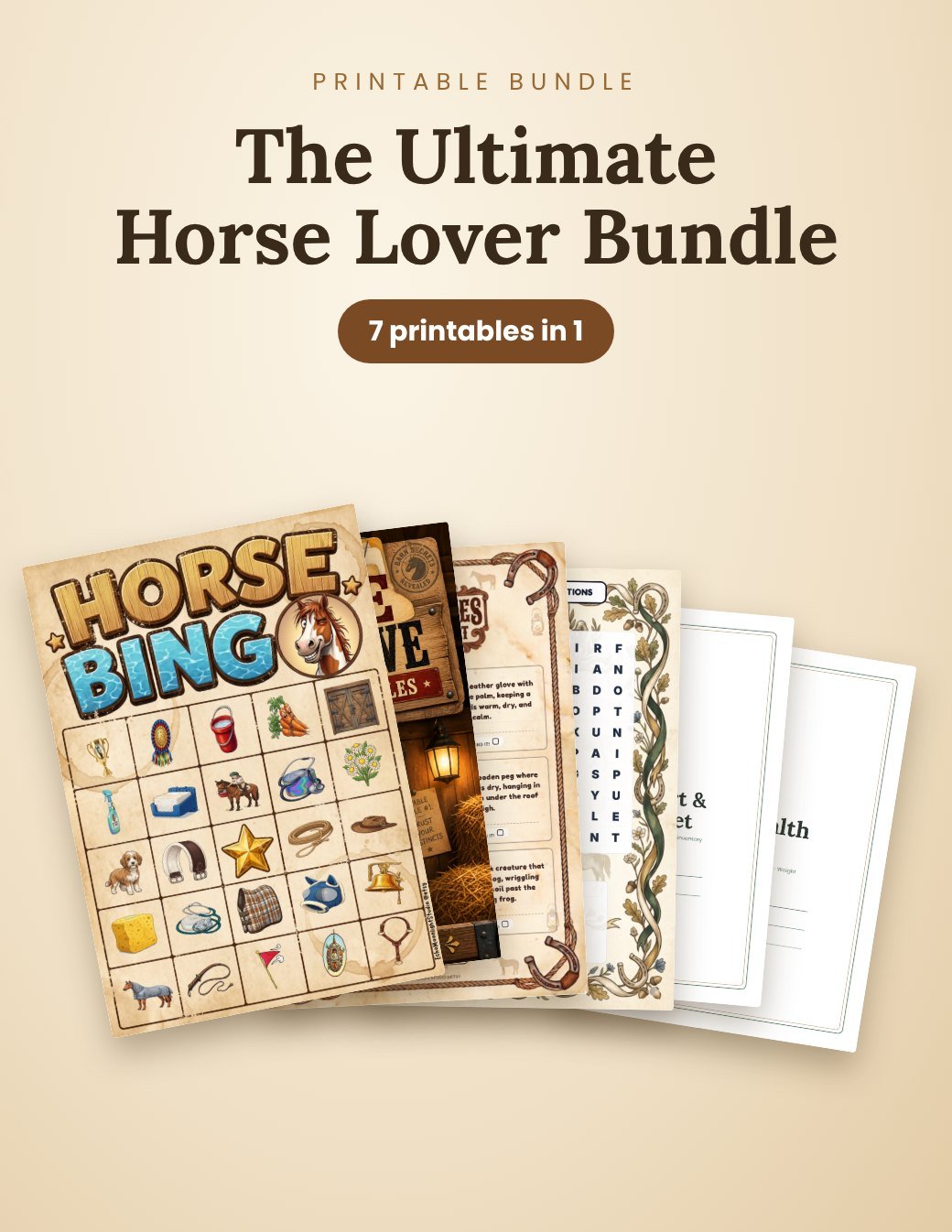
The Ultimate Horse Lover Bundle
Write up this ration on a fillable Feeding Chart & Stall Card set: daily feeding chart, barn feeding board, supplement schedule and stall cards. It comes in the Ultimate Horse Lover Bundle with 6 more horse printables, $12.99.
Frequently asked questions
Does my horse need hard feed?
Many don’t. Good doers and horses in light work can usually get all the energy they need from forage, plus a balancer for vitamins and minerals. Hard feed is mainly for poor doers and horses in harder work.
Does grazing count?
Yes, and it can provide a lot of energy, especially in spring. This calculator doesn’t include grazing, so if your horse is out on good grass, it will need less hay and hard feed than shown.
What is MJ of DE?
MJ stands for megajoules, a unit of energy. DE means digestible energy, the part of the feed’s energy the horse can actually absorb. UK feed companies list the DE on the bag in MJ/kg. In the US, energy is usually given in megacalories (Mcal) instead, and 1 Mcal equals 4.184 MJ.
Does this work for foals, broodmares and older horses?
Not reliably. Growing youngsters, pregnant and nursing mares, and older horses that struggle to keep weight on have different needs. Speak to an equine nutritionist or your vet, or use the free helpline most feed companies offer.
This calculator gives an estimate only and is not a substitute for advice from your vet or an equine nutritionist.
🐴 Looking For More Free Equestrian Tools?
We’ve built a whole collection of tools just for horse lovers! Whether you need to figure out your horse’s winter blanket size or calculate your winter hay budget, we’ve got you covered.
Explore All Free Tools