
Horse Weight Loss Calculator
Has your vet or farrier said your horse or pony needs to lose a few kilos (or pounds)? Losing weight slowly and steadily is the safest way to do it, and it helps protect overweight horses from laminitis.
Use this free weight loss planner to set a realistic target, see how long it should take, and work out how much hay to feed along the way.
Weight Loss Planner
Set a safe target, timeline and daily hay amount
How to help your horse lose weight safely
Most overweight horses and ponies got that way slowly, and they should lose it slowly too. A safe rate for most horses is roughly 0.5% to 1% of their bodyweight a week. For a 550kg (1,210lb) horse that means about 3 to 5kg (6 to 12lb) a week. Crash diets don’t work for horses. Long gaps without forage raise the risk of gastric ulcers, colic and behaviour problems, and in ponies, donkeys and miniatures a sudden cut in feed can trigger hyperlipaemia, which can be fatal.
If you don’t know your horse’s weight, start with our horse weight calculator. Then measure again in the same way every two weeks so you can see the trend.
Step 1: Check body condition, not just weight
Weight on its own doesn’t tell you whether a horse is fat. A big-boned Warmblood and a fat cob can weigh the same. Vets use a body condition score (BCS), usually on the 1 to 9 Henneke scale used in both the US and UK, to judge fat cover over the neck, shoulder, ribs, back and tailhead.
| Score | What you’ll see and feel |
|---|---|
| 5: Ideal | Back is level. Ribs can be felt easily but not seen. Fat around the tailhead feels spongy. |
| 6: Moderately fleshy | Fat over the ribs feels soft. There may be a slight crease down the back. |
| 7: Fleshy | You can still feel individual ribs, but there is noticeable fat between them. Fat is building along the neck and behind the shoulder. |
| 8: Fat | Ribs are hard to feel. There is a clear crease down the back, a thick crest and fat on the inner thighs. |
| 9: Extremely fat | There is patchy fat over the ribs, a bulging crest and fat filling the flank. The thighs may rub together. |
As a rough rule, each condition score above 5 is around 4% of bodyweight, or about 20kg for a 500kg horse (about 45lb for a 1,100lb horse). The planner uses this to suggest a starting target, but your vet is the best person to confirm it. Not sure of your horse’s score? Use our body condition score checker, which has pictures of each score.
Step 2: Get the forage right
- Feed by weight, not by eye. Weigh hay with a hanging luggage scale. Most horses on a diet should get around 1.5% of their current bodyweight in forage a day. Don’t go lower without advice from your vet.
- Choose lower-calorie hay. Mature, stalky hay is usually lower in sugar and calories than rich, leafy hay. A forage analysis takes out the guesswork.
- Make it last. Use small-holed haynets, double netting or several nets spread around the stable so your horse eats slowly and isn’t left without fibre for hours.
- Soaking. Soaking hay in clean water can lower its sugar content, which is often advised for horses prone to laminitis. Ask your vet how long to soak for your horse.
- Cut out the extras. Most good doers don’t need hard feed. A forage balancer gives vitamins and minerals without adding many calories.
Use our hay calculator to turn the daily amount into a weekly or monthly hay budget.
Step 3: Manage grazing
Grass can provide far more calories than hay, especially in spring and autumn. Options include strip grazing, a track system, a bare or “starvation” paddock with hay (often called a dry lot in the US), or a grazing muzzle for part of the day. Introduce changes gradually and make sure a muzzled horse can still drink easily.
Step 4: Add exercise
Regular exercise burns calories and improves insulin sensitivity, which matters for horses with equine metabolic syndrome (EMS). Build up slowly. Even brisk walking in hand or on a horse walker helps. Horses that have had laminitis should only exercise once their vet says it is safe.
Step 5: Track progress
Measure the heart girth and body length with a tape every two weeks, at the same time of day, and record the results. Take photos from the side and behind in the same spot. If weight stops coming off for a month, look again at grazing and hay amounts before cutting forage further.
Frequently asked questions
How quickly can a horse lose weight?
Around 0.5% to 1% of bodyweight a week is a sensible target for most horses, which is roughly 2.5 to 5kg a week for a 500kg horse, or about 5.5 to 11lb a week for a 1,100lb horse. Many owners find progress is slower in spring and summer when grass is growing.
Why is my overweight horse a risk for laminitis?
Obesity is often linked with insulin dysregulation and EMS, which are major causes of laminitis. Bringing your horse back to a healthy condition is one of the most effective ways to reduce that risk.
Can I just stop feeding hay overnight?
No. Horses are designed to eat little and often, and long periods with an empty stomach can cause ulcers and colic. Restrict the total amount of forage and slow down how fast it is eaten, but don’t remove it altogether.
Are ponies and donkeys different?
Yes. Ponies, donkeys and miniature horses gain weight easily, but they are also prone to hyperlipaemia if their feed is cut too quickly. Always make changes gradually and involve your vet, especially if the animal is very overweight, elderly or pregnant.
This planner gives general guidance only and is not a substitute for advice from your vet. Speak to your vet before starting a weight loss plan, particularly if your horse has laminitis, EMS or PPID (Cushing’s).
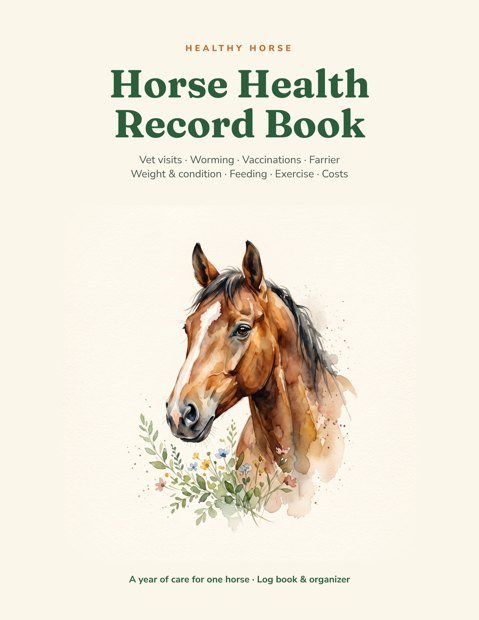
Horse Health Record Book
Log weight and condition scores, vet visits, worming, vaccinations, farrier and dentist appointments, feeding and exercise for a whole year. A 100-page printable in US Letter and A4.
🐴 Looking For More Free Equestrian Tools?
We’ve built a whole collection of tools just for horse lovers! Whether you need to figure out your horse’s winter blanket size or calculate your winter hay budget, we’ve got you covered.
Explore All Free Tools